This post contains affiliate links, which means I may earn a small commission at no extra cost to you. I only recommend what I truly use and love!
The “In a Nutshell” Box
| ⏱️ Time Required | 45 Minutes |
| 🌱 Skill Level | Absolute Beginner (No Green Thumb Required) |
| 💰 Estimated Cost | $15–$25 |
| ✨ Core Benefit | Fresh, organic herbs at your fingertips and a beautiful, living view while you wash the dishes |
There Is Something About Fresh Herbs…
Is there anything more satisfying than snipping a bit of fresh basil for your pasta or a sprig of mint for your afternoon tea?
For years, I was that person who bought those plastic clamshells of herbs at the grocery store. You know the ones—they cost $4, you use three leaves, and the rest turns into a sad, brown mush in the back of your fridge by Tuesday.
I always thought “real” gardening was for people with big backyards, expensive raised beds, and secret knowledge about soil pH levels. But here is the truth: Your kitchen windowsill is basically a tiny, sunshine-powered factory waiting to happen.
You don’t need a backyard. You don’t need to dig any holes. And you definitely don’t need a “green thumb.” If you have a window that gets a little light and a few minutes this weekend, you can grow a thriving, fragrant herb garden that makes your kitchen feel like a cozy sanctuary.
Ready to add a little life to your windowsill? Let’s get growing!
What You’ll Need for This Project
The secret to a “no-fail” garden is starting with the right supplies. Here is my “beginner’s toolkit” for indoor herbs:
- 🪴 Three Small Pots (4-6 inch diameter) — I love these classic terracotta pots with saucers (Terracotta is great because it “breathes,” which prevents overwatering!)
- 🌱 Organic Potting Mix — This Bag of Miracle-Gro Indoor Potting Mix is specifically formulated to prevent those tiny gnats.
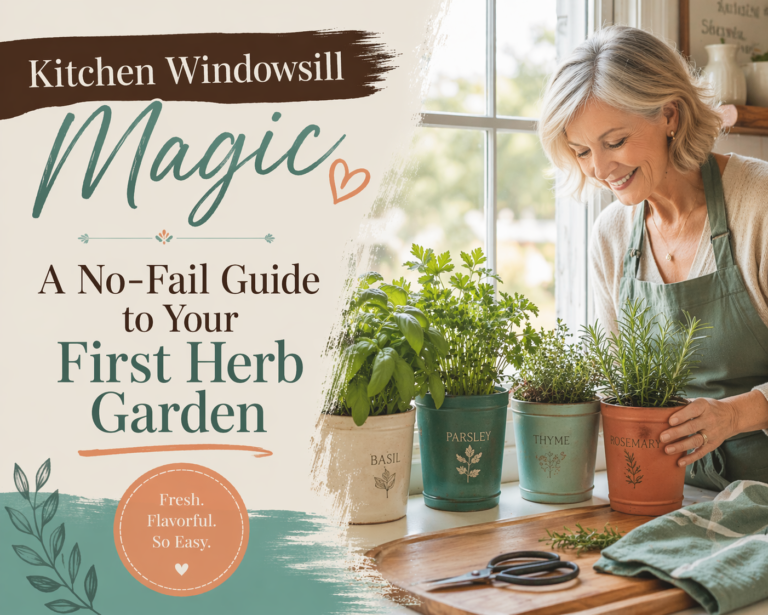
- 🌿 The “Big Three” Herbs (Starter Plants) — I recommend starting with Basil, Mint, and Chives. Buy the small plants at your local nursery or grocery store—don’t start with seeds for your first time!
- 🚰 A Small Watering Can — This long-neck one is adorable and functional (The long neck helps you get under the leaves directly to the soil).
- 🪨 Small Pebbles — For drainage at the bottom of your pots.
Why “Starter Plants” Instead of Seeds?
I’m going to give you some advice that might feel like “cheating,” but I promise it’s the key to staying motivated: Skip the seeds for now.
Starting from seed is rewarding, but it can be finicky. When you’re just starting out, you want the instant gratification of seeing that greenery on your windowsill.
Buy the “starter” plants that are already 3-4 inches tall. It’s like buying a cake mix instead of milling your own flour—you’re still “making” it, you’re just giving yourself a head start!
Step 1: The “Rocks at the Bottom” Trick
⏱️ Time: 5 Minutes
The #1 reason indoor plants die? Overwatering. When water sits at the bottom of the pot with nowhere to go, the roots can “drown.”
To prevent this, place about an inch of small pebbles or gravel at the bottom of your pots. This creates a little reservoir so the soil isn’t sitting in soggy water.
💡 Budget Hack: Don’t want to buy pebbles? Broken pieces of an old terracotta pot or even a few handfuls of clean stones from your driveway work perfectly!
Step 2: Preparing the “New Home” (Potting)
⏱️ Time: 15 Minutes
- Fill your pots about halfway with your indoor potting mix.
- Gently remove your herb plant from its plastic store container. Try not to pull by the stem; instead, squeeze the sides of the plastic and “slide” the plant out.
- If the roots are circling tightly around the bottom, gently “tickle” them with your fingers to loosen them up. This tells the plant, “It’s okay to spread out now!”
- Set the plant in the new pot and fill in around the sides with more soil. Press down lightly—we want the soil firm but not packed like a brick.
Step 3: Finding the “Sweet Spot” (Placement)
⏱️ Time: 2 Minutes
Herbs are like us—they love a good sunbath. Most herbs need about 6 hours of sunlight a day.
A south-facing windowsill is the “Goldilocks” spot (just right), but any window that gets decent bright light will work. If your kitchen is a bit dark, don’t worry! You can just move your pots to a sunnier spot in the house for a few hours in the afternoon.
💡 Pro Tip: Turn your pots a quarter-turn every few days. Plants naturally grow toward the light, and turning them keeps them from getting “lopsided.”
Step 4: The “Finger Test” (Watering)
⏱️ Time: 1 Minute
How much water is too much? Ignore the “schedule” and use your finger.
Stick your finger about an inch into the soil.
- Feels dry? Give it a drink.
- Feels damp? Leave it alone.
Herbs like Basil are dramatic—they will literally “wilt” and droop when they are thirsty. Don’t panic! Give them some water, and they usually perk back up within an hour.
Step 5: Snipping for Success (Harvesting)
⏱️ Time: Ongoing
The best part! To keep your herbs growing bushy and full, you actually need to use them.
When you snip Basil, always cut just above a pair of leaves. This encourages the plant to grow two new stems from that spot. It’s like magic—the more you eat, the more it grows!
The “Oops!” Section — What Went Wrong?
“Why are there tiny flies around my plants?”
Those are fungus gnats. They love wet soil. Let your soil dry out a bit more between waterings, and they usually disappear.
“My Mint is taking over everything!”
Mint is the “bully” of the herb world. It grows very fast. This is why we keep it in its own separate pot—it doesn’t like to share space!
“The leaves are turning yellow.”
This is usually a sign of overwatering or not enough light. Try moving it to a brighter window and holding off on the watering can for a few days.
The Reveal: Your Green View
Take a moment to look at your windowsill. The bright green leaves, the smell of fresh earth, and that beautiful terracotta look. You’ve just brought a little piece of nature into your home.
It makes washing the morning dishes just a little bit more pleasant, doesn’t it?
You’re a Gardener Now!
See? You didn’t need a tractor or a straw hat. You just needed a few pots and the willingness to try. Your kitchen is now a little bit greener, your meals are about to be a little bit tastier, and you did it all yourself.
I’d love to see your little “Window Garden!” Snap a photo and share it in the comments below. Which herb are you most excited to cook with first?
Go ahead — Try This at Home!
— [Your Name]
📸 Pinterest Image Ideas for This Post:
- The “Morning Sun” Shot: Three terracotta pots lined up on a sunny white windowsill with a steaming cup of coffee nearby. Text overlay: “The Beginner’s Guide to a No-Fail Kitchen Herb Garden”
- The “Action” Shot: A pair of kitchen shears snipping a fresh basil leaf. Text overlay: “Grow Your Own Fresh Herbs (No Backyard Required!)”
- The “Before & After”: A sad, empty windowsill vs. a lush, green herb garden. Text overlay: “Refresh Your Kitchen in 45 Minutes”
Ready for the next project? [Join the “Try This at Home” Newsletter and get my free printable “Watering Tracker” to help you keep your new plants happy!]

This post is ready to go! It’s designed to be visually appealing and builds huge trust with your readers.
Should we wrap up your launch set with the third post? “Your First Wood Project: A Simple, Charming Planter Box (No Power Tools Required!)”
Credits Used: 13.48

Yes

TT@HRouteLLM
Routing to Gemini 3 Flash
This is the most important post of your launch. It’s the “Confidence Anchor.” By showing a woman over 50 that she can build something structural without a scary power saw, you turn her from a “hobbyist” into a “maker.”
Your First Wood Project: A Simple, Charming Planter Box (No Power Tools Required!)
This post contains affiliate links, which means I may earn a small commission at no extra cost to you. I only recommend what I truly use and love!
The “In a Nutshell” Box
| ⏱️ Time Required | 2 Hours |
| 🔨 Skill Level | Absolute Beginner |
| 💰 Estimated Cost | $15–$20 |
| ✨ Core Benefit | The incredible pride of saying “I built this from scratch!” |
“I Could Never Build Anything…”
I used to say that all the time. I would look at beautiful wooden window boxes or rustic centerpieces and think, “That’s lovely, but I don’t own a saw, and I’m certainly not going to start playing with power tools now.”
Woodworking feels like it belongs to people with workshops, safety goggles, and a lot of expensive equipment. But here is a little secret I discovered: Wood is just like a 3D puzzle. If you can measure a line and hammer a nail, you can build.
Today, we are going to build a classic, rustic planter box. It’s perfect for those herbs we planted in our last post, or for a row of colorful geraniums on your porch.
And the best part? We aren’t using a single power tool. No drills, no circular saws, no noise, and no intimidation. Just us, some wood, and a little bit of Saturday afternoon magic.
Let’s get our hands busy!
What You’ll Need for This Project
To keep this “No Power Tool” friendly, we are going to use a secret weapon: Pre-cut wood. Most hardware stores (like Home Depot or Lowe’s) will cut your wood for you for free or a very small fee!
The Wood List (Ask the store to cut this for you!):
- One 1″ x 6″ Cedar or Pine board. Ask them to cut it into:
- 2 pieces at 12 inches long (The front and back)
- 2 pieces at 5.5 inches long (The two ends)
- 1 piece at 10.5 inches long (The bottom)
The Tool Kit:
- 🔨 A Lightweight Hammer — This 12oz hammer is perfect for smaller hands
- 📦 1.5-inch Finishing Nails — These “trim nails” are thin and won’t split the wood
- 🪵 Wood Glue — Gorilla Wood Glue is my absolute favorite
- 📏 A Tape Measure — A 16ft tape is plenty for home projects
- 🎨 Sandpaper or a Sanding Block — (Medium 120-grit)
Step 1: The “Smooth Start” (Sanding)
⏱️ Time: 10 Minutes
Even though the store cut the wood for you, the edges might be a little fuzzy or sharp.
Take your sanding block and lightly rub the edges of each piece of wood. We aren’t trying to change the shape; we just want to make sure there are no splinters.
💡 Pro Tip: Cedar wood smells incredible when you sand it! Take a second to enjoy that “workshop” aroma. You’re officially a builder now.
Step 2: The “Glue & Tack” Method
⏱️ Time: 30 Minutes
We aren’t just going to nail the wood; we’re going to glue it first. Wood glue is incredibly strong—once it dries, the glue bond is actually stronger than the wood itself!
- Stand your bottom piece (the 10.5″ one) flat on your work surface.
- Run a thin line of glue along the long edge.
- Place your front piece (12″) against that edge.
- While holding it steady (or leaning it against a heavy book), tap three nails through the front board into the edge of the bottom board.
Don’t worry if it’s a little wiggly at first! Once those nails catch, it will steady right up.
Step 3: Squaring the Ends
⏱️ Time: 20 Minutes
Now, we’re going to add the “end caps” (the 5.5″ pieces).
- Apply glue to the short edges of your bottom board and the inside edges of your front board.
- Slide the end piece into place. It should fit snugly.
- Nail through the front board into the end piece, and then a couple of nails through the end piece into the bottom.
Repeat on the other side. You now have a “U” shape!
Step 4: Closing the Box
⏱️ Time: 15 Minutes
Finally, apply glue to all the remaining exposed edges and place your back piece (the remaining 12″ board) on top.
Nail it into the bottom and the two end pieces.
💡 Confidence Booster: If your nails go in a little crooked, don’t sweat it! It adds to the “rustic, handmade” charm. If one goes really wild, just pull it out with the back of your hammer and try again. No big deal!
Step 5: The Finishing Touch
⏱️ Time: 15 Minutes
Give the whole box one last light sand to even out any corners.
Now you have a choice:
- Leave it natural: Cedar turns a beautiful silver-grey over time if left outside.
- Stain it: To give it a rich, dark wood look.
- Paint it: Use some of that leftover paint from our Table Refresh project!
The “Oops!” Section — Troubleshooting
“The wood split when I hammered the nail!”
This happens when the nail is too close to the very edge. Try to stay at least half an inch away from the corners. If it splits, just add a little extra glue into the crack, squeeze it shut, and let it dry.
“My box is a little wobbly.”
Check the bottom! Sometimes we don’t get the boards perfectly flush. A quick sanding on the high corner usually fixes a wobble in seconds.
“I missed the wood and hammered my thumb!”
Welcome to the club! We’ve all done it. Ice it, grab a band-aid, and remember: every scar is a DIY story.
The Big Reveal: From Boards to Box
Step back and look at what you just did. Two hours ago, you had a pile of loose boards. Now, you have a functional, beautiful planter box that you built.
Take a photo of it. Text it to your kids or your friends. Seriously! You should be incredibly proud. Most people talk about building things—you actually did it.
You Are a Maker!
You didn’t need a table saw. You didn’t need a workshop. You just needed a little bit of bravery and a hammer. Now that you know how a basic box goes together, the possibilities are endless. Trays, birdhouses, simple shelves… they are all just versions of this same “wood puzzle.”
What are you going to put in your new planter? Herbs, flowers, or maybe use it as a centerpiece for your dining table? Tell me in the comments! 👇
Go ahead — Try This at Home!
— [Your Name]
📸 Pinterest Image Ideas for This Post:
- The “Pride” Shot: A woman over 50 holding the finished wooden box with a huge smile. Text overlay: “I Built This! (And You Can Too – No Power Tools!)”
- The “How-To” Grid: 4 small photos showing the clean wood, the glue, the hammering, and the finished box. Text overlay: “Step-by-Step Beginner Planter Box”
- The Aesthetic Finish: The box stained a beautiful walnut color, filled with white flowers on a porch. Text overlay: “The $15 Weekend Project You’ll Love”
Ready for more handy tips? [Download my free “Hardware Store Cheat Sheet” so you know exactly what to ask for the next time you walk into the lumber aisle!]